• It would be nice to have the fixed zoom settings with more steps in-between (e.g. 75%, 125%, 150%, etc.), as you use the scroll wheel of the mouse;
• it would also be nice to have the option to quickly set custom colors via the options to easily change the UI colors; this would be about having very basic settings to set the UI colors.
The reason you can’t zoom to more in-between steps is because Aseprite is designed for pixel art, and if you zoom 125% your art will become distorted, so it’s locked to whole zoom steps so all the pixels remain equal size. If you zoom 150% then that means half of the pixels are twice as big.
Allow me to revive this thread. While i like it to be easy to zoom to whole pixel sizes, it would make the user experience a lot more smooth, if you could zoom in/out gradually. You get a crisp look with whole pixels, but with an hd+ monitor eg. 150% can still look sharp.
Like in photoshop when holding alt/cmd+space and dragging the mouse, and it zooms like a camera lens – or at least have some more steps.
Mostly i miss ctrl/cmd+0 , which in Aseprite enlarges the pic to largest whole pixels and in ps makes the picture fill the screen completely. I miss that feature from ps a lot in Aseprite!
SO, if anyone sees this who knows how to script for Aseprite (i only do visuals myself) – a script for this would be really appreciated! I don’t know if it’s on the milestone for Aseprite, but don’t think so?
I’m quite convinced the reason people want middle steps for zoom is actually because of the default 200% screen scaling which makes the first zoom step feel massive. I always recommend people to switch to 100% screen scaling 200% ui scaling to fix it.
Also you really don’t get a good look at anything with half steps tbh. Even if you’re zoomed out to only
150% with a high res monitor you’re still getting massive distortion in your image.
Maybe if there could be a setting to enable more steps manually, like an input box that shows all the steps and you can just add “, 150,” to add another one, but imo it’s mostly pointless and as default it would be a very bad idea.
Thank you! I had my Screen Scaling and UI Scaling percentages swapped from your suggestion. And — yes, the first zoom felt massive.
Following your suggestion, my UI appears the same size, but I get more nuanced zooming. The 150% I wanted before is now 300% — and it’s the zoom I was looking for. Awesome.
People on these posts keep on talking about “half steps” and “pixel splitting” as reasons why you can’t have a functional zoom in Aseprite, but they don’t know what they are talking about. It’s a bad excuse used over and over again to defend the program.
(“Half step” and “splitting” means splitting the pixels in some pixel art such that, for example, on your monitor some might be 2 pixels wide and others might be 3. And this looks very bad.)
It needs to be pointed out that the web has solved this problem about 30 years ago. When you render a font, is the font pixel perfect? No way. Especially not in 1998. Then how does it look fine? Isn’t the pixels splitting in the characters in the font? They are, and big time. The reason you don’t notice it is because of anti-aliasing and other rendering techniques. The reason you DO notice it in Aseprite is because they don’t do any of this. It was never implemented. It could have been implemented, but it wasn’t. It should have been.
The same is true when you resize an image (not in Aseprite but just in general on your computer) and how it splits pixels. This was also solved 30 years ago. When you open an image on your computer and resize it, it will probably look ok no matter the size because, although pixels are getting split, the renderer on your OS is able to handle it.
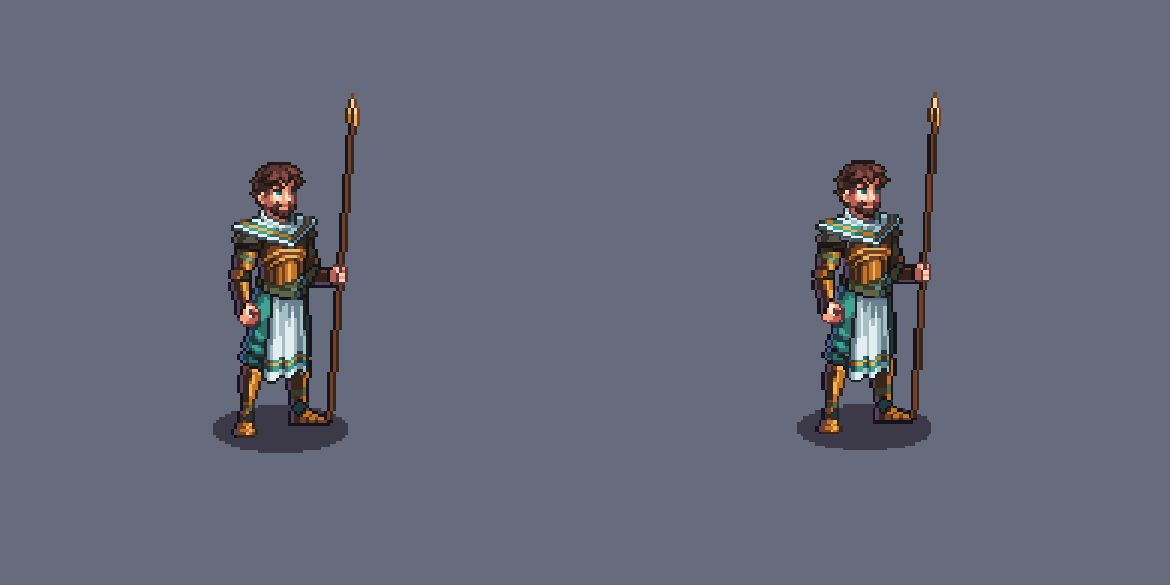
If you want proof, then take the image posted above of the priest character with the staff. The one on the left is fine and the one on the right has “pixel splitting” problems. The poster said that a weird zoom in Aseprite caused the pixel splitting. However, if you take the one that is fine and put it in chrome and zoom in and out, you will not see any pixel splitting or jank. It’s still there, but Chrome’s renderer is sophisitcated and hides it well, so well that you can’t even see it.
The people who are saying this problem of zoom is not solvable are clearly wrong. The reality is that this is genuine situation where the Aseprite devs really dropped the ball and messed up.
@John_Miller we are already working on a rewrite of the render engine https://github.com/aseprite/aseprite/issues/3516 for v1.4. At the end we should be able to render the editor in any zoom (even rotation/flips). But it’s an on going process.